Terry Flew
On December 10, 2025, the Online Safety Act (Social Media Minimum Age) Amendment, which was passed by both Australian Federal Houses of Parliament 12 months earlier, was implemented. This marked the onset of what is known globally as Australia’s social media ban for under-16s. In practice it involves those under 16 being restricted from holding accounts on ten platforms designated by the Office of the eSafety Commissioner, including Facebook, Instagram, TikTok, X, Reddit and Snapchat.
The introduction of these laws was a subject of great interest globally. Australian Internet and social media researchers were in high demand for their thoughts, insights and opinions on the topic. I did live TV interviews with CNN, Al Jazeera, China Media Group, Bloomberg TV and the ABC, as well as radio with the BBC, The Times Radio, Arirang Radio, LBC and CGTN Radio. Interviews were conducted with journalists from Latvia, Brazil, Germany, Spain, France, Japan, China, Singapore, Canada, the UK and the US, as well as several Australian media outlets.
The paper on the path to the new laws co-authored by Agata Stepnik, Tim Koskie and myself, ‘Digital policy as problem space: policy formation, public opinion, and Australia’s Online Safety Amendment (Social Media Minimum Age) Act 2024’, has now been published by Media International Australia. In the paper, we sought to ground the debate about these laws in a conceptual framework derived from the British sociologist Celia Lury’s notion of problem spaces, of the environments in which problems are constructed, evidence is gathered, and solutions are proposed; what Lury has termed ‘the problem of the problem’, and its relationship to methodology.
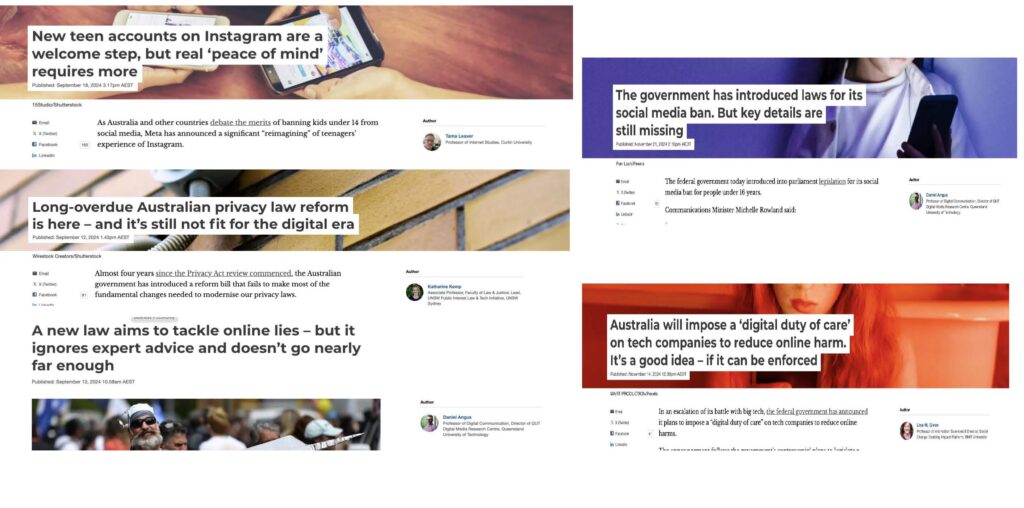
This allowed us to get beyond simply engaging in advocacy for or against the legislation. As can be seen in the images above, which are headlines for various expert pieces published in The Conversation in the latter part of 2024, the debate around the social media age restrictions and other issues has been ongoing for some time in Australia.
It was noted that the Social Media Minimum Age Amendment comes at a time of greater commitment on the part of nation-state governments around the world to greater regulation of tech companies. I have written about this regulatory turn in Regulating Platforms and in various reports and academic papers (see here and here for examples). Following Cioffi, Kenney and Zysman’s innovative application of Karl Polanyi’s The Great Transformation (1941) to the age of global tech giants, we can see a three-stage process in play.
As with the rise of manufacturing during the Industrial Revolution, the open Internet triggers monopolisation through the global digital platforms, and resulting power imbalances and adverse social consequences trigger citizen demands for action by governments to tame the power of the tech giants. How to do this is complicated, but in terms of the global nature of the platforms and the technicalities involved in relegation, but there is evidence of a significant – if at times incoherent – response to the abject failure of industry self-regulation in the digital tech sector over a 20-year period.
We also sought to track public debate on the issue. We did this through a small-scale meta- analysis of 22 surveys published over the 2019-2024 period. Noting that these deal with a range of topics across the categories of Safety and Security, Data Privacy and Information Disorder, and noting that the issue salience of social media regulations varies over time, what we clearly saw was a demand from those surveyed that governments ‘do something’ about social media and its impact on young people.
Public support for a social media ban for under-16s remains highly durable: it had 61% support in August 2024, and by November 2024 – after the arguments against as well as for such a measure had been in the public domain – public support was 77%. When the laws came into operation in December 2025, the measure had 67% support, with 15% opposed and 18% undecided. The policy thus represents a fascinating case study in the divergence between popular opinion and (some) expert opinion.
We also undertook a review of submissions to the Joint Select Committee on Social Media and Australian Society, which released its Final Report in November 2024. Using Robert Gorwa’s platform governance triangle, we noted that the issues being raised were multi-faceted, including the future of public interest journalism, disinformation, and illegal content disseminated over social media as well as age verification questions.
The largest engagement by firms was with journalism issues such as the future of the News Media Bargaining Code, and NGOs were strongly engaged across all for the topic areas, as were academics. But for individual submitters, contributions on the question of age verification for social media use was far greater than that for other topics. This again supports the proposition that the move towards social media age restrictions has been generated as much by ‘bottom-up’ public concerns as it has by ‘top-down’ government actions.
The introduction of such legislation brings complex questions both to how the laws are to be enacted, and to the underlying principles behind the laws. The latter is particularly important, as similar measures are being actively considered in a number of countries, including Denmark, Norway, France, Malaysia and New Zealand, as well as a number of US states.
This Australian policy is also proving to be at the forefront of global debates about the future of social media governance and Internet regulation. Governments around the world, and particularly in Europe, are considering issues around young people and mental health as well as a global Internet governance landscape where the corporate social responsibility agenda among tech companies in the US is moribund, if not completely dead under Trump.