Latest Blog

Killing the chicken to scare the monkey: the curious progressive urge to take down Australia’s social media minimum age rules

Evidence from Australia after three months of the Online Safety (Social Media Minimum Age Amendment) Act is that outcomes have been ambiguous. A Compliance Update Report released by the Office of the eSafety Commissioner in March 2026 found that while almost half of surveyed parents had at least one child with their own social media account prior to the restrictions coming into effect, this proportion had decreased to nearly one third following implementation of the ban. Notably, of the parents who reported their child had an account on each platform prior to 10 December 2025, around 7 in 10 reported that their child still had an account, with only 3 in 10 reporting that their child no longer had an account.

Why we are not in a post-truth era

Discussions about trust have characteristically tied the concept closely to that of truth. When we are asked why we consider a particular person trustworthy, the question of whether they tell the truth is likely to feature highly. As the great physicist and Nobel Prize winner Albert Einstein observed, ‘Whoever is careless with the truth in small matters cannot be trusted with important matters’.

To age-gate or not to age-gate? The Australian Social Media Minimum Age legislation and its international impact

When Australia implemented the world’s first legislated social media minimum age  restrictions on 10 December 2025, it attracted significant global attention. The Australian Science Media Centre recorded that the 52 academics registered as experts on the subject were sourced in over 2600 news items worldwide in December 2025 alone. It was extensively covered by virtually every major international news outlet, and I did interviews with BBC, CNN, Al-Jazeera, The Times, Asahi Shimbun and many others.  

Time for Trust: Can we trust Hollywood?

In this episode, Associate Professor Bruce Isaacs dives into the crisis of trust in images – from Hollywood to Instagram – and explains why we may no longer know what’s real. It’s a timely, provocative discussion about how cinema, digital media and AI are reshaping our relationship to truth itself.

Summer Reflections on Australia’s Social Media Minimum Age Laws

It is unusual to find yourself as a digital media researcher in Australia being at the forefront of global policy debates. Given the talk about the three great Digital Empires – the US, EU and China – who set the global agenda, the place for middle-sized powers to be taking a policy lead around digital tech would seem to be limited.

How do Platforms Matter?

The paper ‘How do platforms matter? Media power, platform power and the digital domination of Australian media’, co-authored by Terry Flew (University of Sydney) and Cameron McTernan (Adelaide University) has now been published by International Communications Gazette. The paper is part of a special issue ‘Networks of Power: Media and Internet Concentration, Platform Capitalism, and the Future of Democracy’, edited by Dwayne Winseck (Carleton University). The special issue is part of the Global Media and Internet Concentration Project (GMICP), funded through the Canadian Social Sciences and Humanities Research Council.

Digital policy as problem space: Australia’s social media age restrictions for under-16s

On December 10, 2025, the Online Safety Act (Social Media Minimum Age) Amendment, which was passed by both Australian Federal Houses of Parliament 12 months earlier, was implemented. This marked the onset of what is known globally as Australia’s social media ban for under-16s. In practice it involves those under 16 being restricted from holding accounts on ten platforms designated by the Office of the eSafety Commissioner, including Facebook, Instagram, TikTok, X, Reddit and Snapchat.

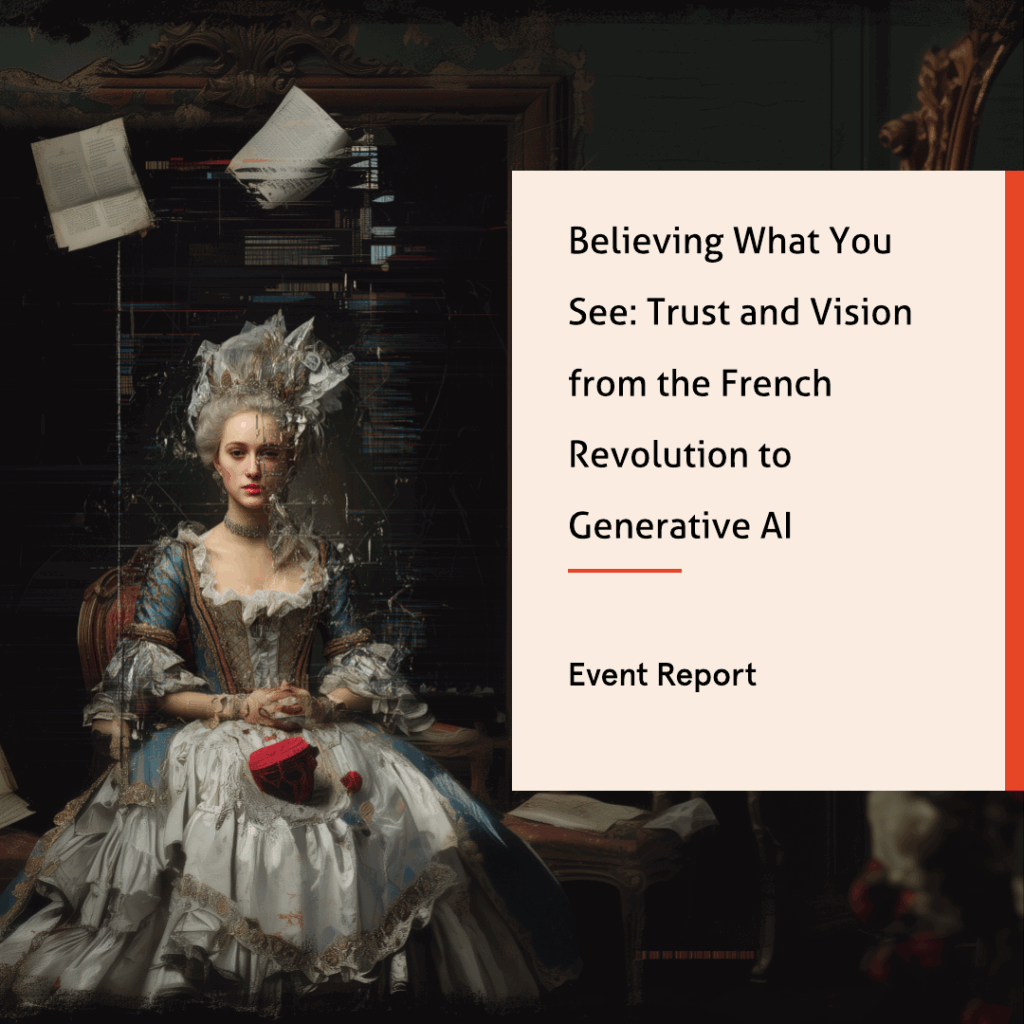
Believing What You See: Trust and Vision from the French Revolution to Generative AI

The seminar brought together a cross disciplinary cohort of scholars to present papers on the veracity of the image and information in public life, and the relationship between visual understanding and societal trust.

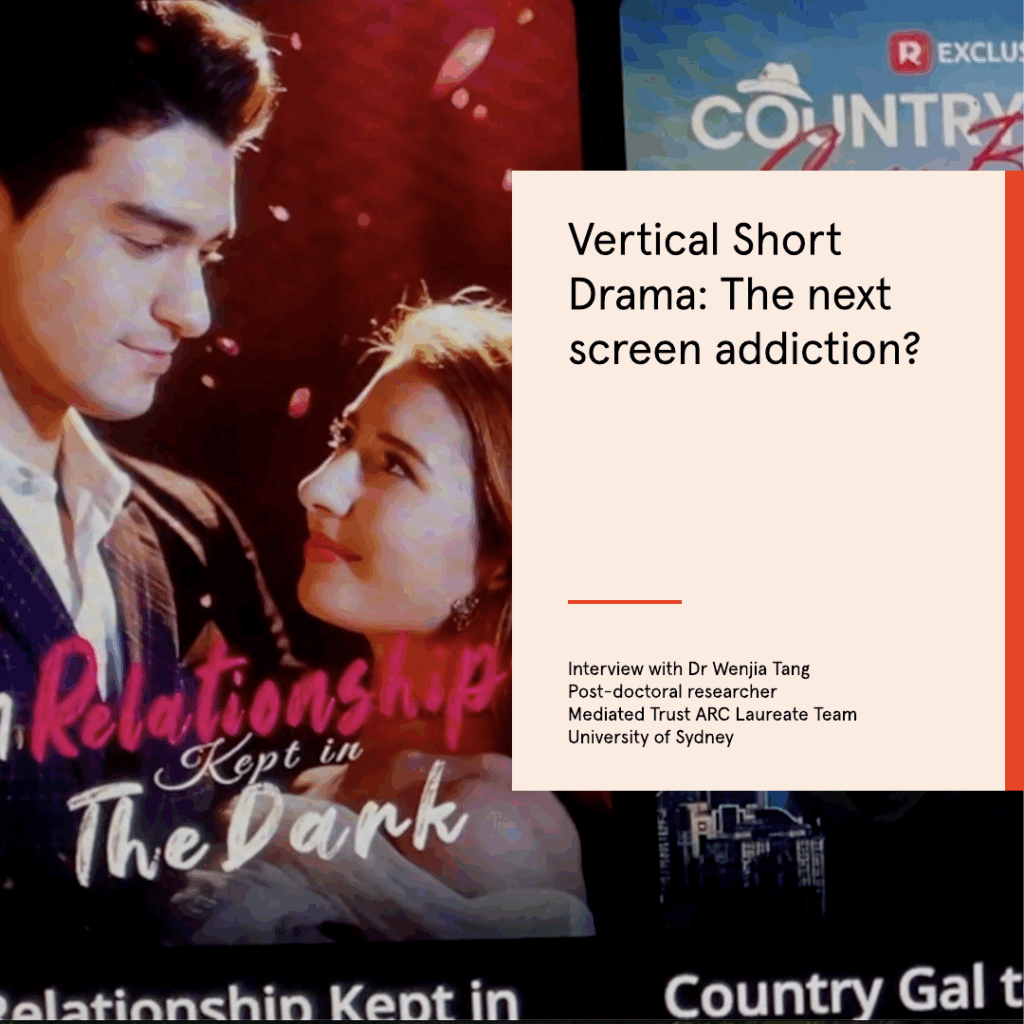
Vertical Short Drama: The next screen addiction? Insights from Dr Wenjia Tang

Dr Wenjia Tang, post-doctoral researcher with the Mediated Trust ARC Laureate team, explores the rise of vertical short drama — a fast-growing format reshaping screen culture. In this talk, Dr Tang examines how mobile-first storytelling platforms are transforming audience habits, merging social media aesthetics with narrative content, and raising new questions about attention, monetisation, and media addiction in the digital age.

Building Trust in Data Science: Interdisciplinary Insights from Rohan Alexander

In this engaging talk, Rohan shares his interdisciplinary journey, collaborative research efforts, and the challenges of building trustworthy, reproducible workflows. From sparse matrices to the evolving role of large language models, he reflects on how AI is reshaping coding practices and the broader implications for society.

AI and Communication: Trust, Ethics, Justice and Policy

Professor Terry Flew was honoured to be an invited keynote speaker for Charles Sturt University’s 50 Years and Beyond: School of Information and Communication Studies “Thoughts on the Beyond” Public Lecture Series. In his address, Professor Flew explored the evolving frontiers of media, communication, and digital society, reflecting on how the past five decades of scholarship can inform the challenges and opportunities that lie ahead.

Dr Agata Stepnik discusses digital ethnography

In this video interview, Post-doctoral research fellow Dr. Agata Stepnik talks about the importance of digital ethnography as a research method and the need for situated and observational methods in understanding digital cultures.