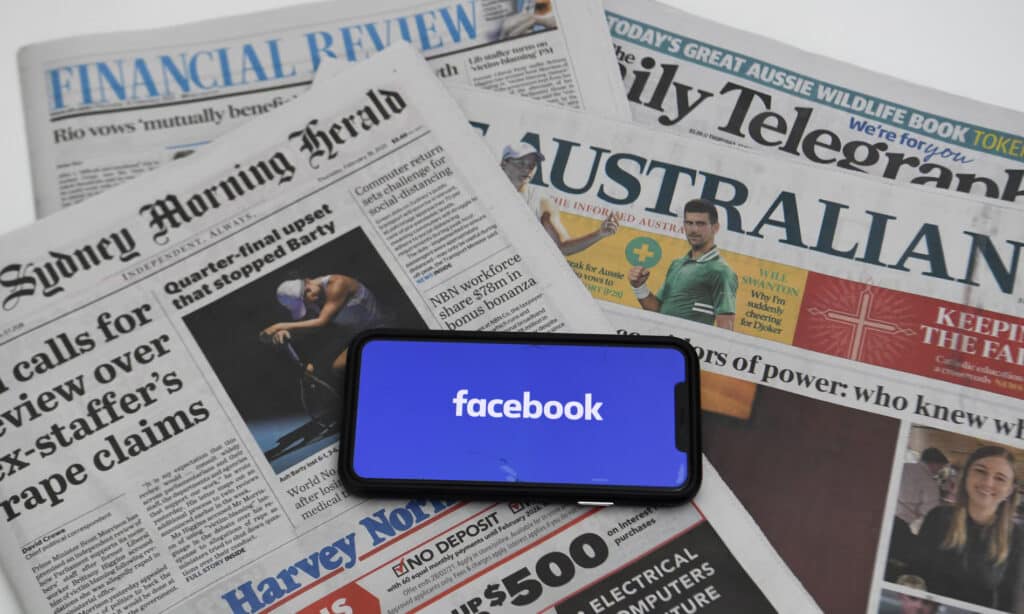
Google and Meta should fund traditional public interest journalism, a new international study reports
Google and Meta account for 70% of digital advertising and should pay a levy to fund traditional media, according to a new report on media concentration led by researchers from several Australian universities.
The communications, media and internet concentration in Australia report, which tracked the country between 2019 and 2022, found it has the second-highest media concentration in the world. Its newspaper sector alone is dominated by four companies who control 84% of the market.
The international study examined the economic dominance of key players in 15 markets across the world. Only Brazil had a higher media concentration than Australia.
News Corp, Nine Entertainment, Seven West Media and Australian Community Media have increased their share, which was 78% in 2019, due to mergers and acquisitions such as Nine buying Fairfax Media in 2018.
Prof Terry Flew and Dr Rob Nicholls from the University of Sydney’s media and communications department say funds from a levy on digital advertising could be invested in journalism.
“A public interest journalism levy, at a rate of about 2%, would generate funds equivalent to or possibly slightly higher than the payments being made under the news media bargaining code,” Flew said.
The proposal of a mechanism to slow down the demise of the newspaper sector echoes comments by Anthony Albanese in August that social media companies shouldn’t “essentially ride free” on the backs of traditional media.
The prime minister was responding to questions about the possibility of a levy after Meta’s decision to not renew media funding deals.
Flew said a levy would be on advertising revenues derived independently of content, and would include News Corp and Nine’s classified advertising of real estate and cars.
The Global Media & Internet Concentration Project’s analysis of the media, telco and internet markets found that Google and Meta dominated internet advertising and were the second and eighth largest communication and media enterprises operating in Australia.
The study defined media enterprises as any company involved in the communication process.
It warned the increase in concentration – due to the rapid ascent of the global tech companies and the deregulation of media markets – poses a major threat to local journalism.
As audiences desert traditional media for global platforms, the study noted, the ability to regulate for accuracy in news, TV and radio is compromised.
“Collating and analysing publicly available revenue and consumer data, we find that from 2019 to 2022, the majority of Australia’s media, internet and communication markets are moderately to highly concentrated,” the report said.
“These results reflect a long history of media concentration in Australia and a continuing trend seen in many developed economies abroad.”
But Flew said journalism faces an even bigger threat than concentration: the “wholesale dismantling” of news driven by the growth in news deserts, the disappearance of commercial newspapers and commercial news bulletins in the regions and the threat of AI-generated online searches no longer linking to news websites.
“The relationship AI will have to search is going to be quite profound,” Flew said.
He said an earlier study showed that the Seven and Nine networks had cut back their news and current affairs coverage from the early 2000s by 70 to 80%. News Corp closed 100 local print newspapers during the Covid pandemic.
“In the digital age of data-driven capitalism and AI and with the dominance of global digital conglomerates and the possible demise of the news media bargaining code, public interest journalism is in jeopardy,” the report said.
Rupert Murdoch owns the biggest media company, controlling a significant share of newspapers, as well as stakes in streaming, online news and pay TV, but News Corp is not locally owned.
Nine Entertainment is the largest Australian media company, with holdings in television, radio, and digital media.
The major four companies in broadcast TV (Nine, Seven, ABC and Network 10) increased their market concentration from 79 to 87%.
The top four players in radio (Southern Cross Media, ABC, ARN and Nova) jumped in market ownership from 57 to 77%.
This article originally appeared in The Guardian. Wrote by Amanda Meade Media correspondent.