
Terry Flew, Professor of Digital Communication and Culture, The University of Sydney; Australian Research Council Laureate Fellow; Co-Director, Centre for AI, Trust and Governance
An edited version of this post appeared in The Policymaker as The policy cycle propelled social media age restrictions, so what can be done to fix it? on July 16, 2026.
The implementation of minimum age restrictions on access to selected social media platforms for under-16s has given Australia a unique position in what has become a global debate about social media age-based bans. Five other countries having now adopted such measures – Indonesia, Malaysia, Vietnam, China and Brazil – and at least 24 other countries considering such policies, including the United Kingdom (UK), France and Canada. As a result, Australia has acquired a position in global Internet policy debates incommensurate with its overall size and significance in the global digital economy.
The rush towards what have been termed ‘social media bans’ has become part of a major global conversation about the adverse impacts that sustained exposure to social media platforms may be having upon young people. It is also a debate about the pros and cons of legislation targeted at social media users as compared to other measures that can influence platform conduct, such as a digital duty of care. There is considerable evidence in many countries that there is majority support for social media bans for under-16s, although there are considerable challenges in moving towards an effective policy.
The UK concluded a three-month national consultation on Growing Up in the Online World in May 2026, which generated over 116,000 responses. The consultation found that 90% of the 54,000 parents of 10-15 year-olds who responded supported restricting access to social media for under-16s, although it also found only 19% of the 14,000 children (under-18s) who responded favoured such a measure.
On the basis of the consultation, the Starmer Labour Government has proposed that an “Australia-plus” social media ban for under-16s should be introduced. In doing so, it was noted in the Department of Industry, Science and Technology’s Progress Statement on the consultation that “there was a range of deeply held, often conflicting, views on what should be done next, especially on the question of whether we should ban social media companies from providing their services to under-16s”.
This is consistent with the period leading up to the introduction of the Online Safety Amendment (Social Media Minimum Age) Act. There was consistent public support for social media age restrictions of around 60-80%, but where there was also significant opposition among academics, children’s rights campaigners and civil society organisations.
The debate in Australia has increasingly turned to the effectiveness of the legislation, with studies finding that about 70-80% of 12-15 year-olds remained on these platforms since the restrictions were introduced. Recognising the risks this presents to the legitimacy of the measures, the Albanese Federal Government announced in late June a doubling of fines for non-compliance to $99 million, and expanded powers for the Office of the eSafety Commissioner to monitor platform age verification measures. These amendments were introduced to Parliament in late June, but the Opposition Liberal-National Parties and the Australian Greens combined to refer the amendments to a Senate Committee.
A Policy Cycle Approach to Understanding the Australian Laws
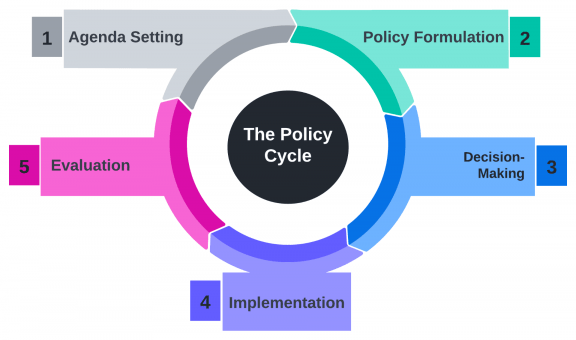
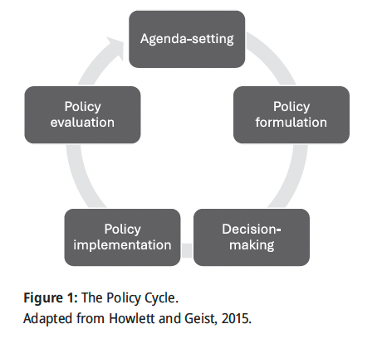
The policy cycle is a familiar method for understanding how and why particular policies come into being. According to Michael Howlett and Sarah Geist, in their 2015 book chapter on the policy-making process, we can see the policy cycles as having five elements, as shown below:
Agenda Setting
In order for a particular issue to become a policy priority for governments, it needs to be sufficiently significant to the public for it to become part of a government’s policy agenda. In the case of the impact of social media on young people, the issues have been apparent for some time. They include concerns about potential psychological impacts, including anxiety, social stress, low self-esteem, and emotional instability and withdrawal, as well as neurological concerns such as over-stimulation, desire reinforcement, compulsive behaviour, and heightened sensitivity to social rejection (also known as Fear Of Missing Out, or FOMO).
The basis on which this issue moved from being a debate among psychologists and medical specialists to becoming a global public conversation was through a bottom-up advocacy process advocacy arising from the publication of NYU Professor Jonathon Haidt’s 2024 book The Anxious Generation. In what can be regarded as an effective instance of policy entrepreneurship, Haidt’s concept of a ‘great rewiring of childhood’ triggered by mass adoption of social media and smartphones by young people struck a strong chord with a diverse constituency of people, particularly parents, teachers and mental health professionals.
As a result, while Haidt’s work has significant academic critics, it has found favour with politicians and other decision-makers who relate to the addiction metaphors it draws upon. Some say that the campaign for such laws in Australia was prompted by the wife of the South Australian Premier, Peter Malinouskas, after she read Haidt’s book. It was taken up by public figures such as Nova FM breakfast radio host Michael Wipfli, whose ’36 months’ campaign to set a minimum age for social media access to 16 received support from Prime Minister Anthony Albanese, after extensive advocacy by parents who had lost their children to mental health issues they saw as triggered through social media.
Policy Formation
Social media minimum age restrictions come from neither the rationalist ‘policy science’ that pioneers of the field such as Harold Lasswell sought, nor are they evidence of the policy incrementalism that scholars such as Charles Lindblom saw as the on-the-ground reality of political decision-making.
They are a new approach to what has been, by the standards of Internet policy, an old problem of how to minimise the potential harms associated with the online environment without losing the benefits of networked connectivity. But they move away from forms of soft law and industry self-regulation that have become the de facto dominant approaches. They mark a return of the nation-state invoking its sovereign territorial authority to apply command-and-control regulations to global digital platforms.
Critics have accused the government of rushing both the consultation process and the framing of the legislation. The timeline shown below indicates that the consultation period was effectively two months in advance of the laws being passed. There were also alternative proposals that were not adopted, such as a Digital Duty of Care recommended by the Rickard Review of the Online Safety Act, while advice about the limitations of existing age assurance technologies was not accepted. The Final Report of the Joint Select Committee on Social Media and Australian Society, where a diverse range of views on social media age restrictions were presented, was released only three days before the Online Safety Amendment Bill was tabled in the House of Representatives, and the Joint Select Committee did not recommend a social media ban.
Timeline of developments for enactment and implementation of Australian Online Safety Act (Social Media Minimum Age) Amendment 2024
| March 2022 | The House of Representatives Select Committee on Social Media and Online Safety found considerable evidence of harm for young people who were also experiencing increased psychological distress. |
| May 2024 | Meeting of Prime Minster and State Premiers commits to a national ban on social media for young people, although there is disagreement about whether the age threshold should be 14 or 16. |
| June 2024 | Federal Opposition Leader Peter Dutton announced his proposal for a national social media age restriction of 16, to be implemented in first 100 days of government if the Liberal-National Party Coalition was elected. |
| Aug 2024 | Joint Select Committee on Social Media and Australian Society releases its Interim Report. Recommends introduction of a Duty of Care provision for platforms. It does not make a recommendation for or against social media age restrictions. |
| 9 Oct 2024 | Australian Child Rights Taskforce releases an open-letter signed by over 100 Australian academics, 20 world-leading international experts, and 20 Australian civil society organisations opposing a social media ban |
| 10-11 Oct 2024 | Social Media Summit is held in Sydney and Adelaide, jointly hosted by the state governments of SA and NSW. Summit supports call for social media age restrictions for under-16s |
| 7 Nov 2024 | Prime Minister Anthony Albanese announces that National Cabinet has endorsed legislation setting 16 as the minimum age for social media use in Australia. |
| 21 Nov 2024 | Australian Human Rights Commission releases statement opposing blanket ban on social media for under-16s. |
| 22 Nov 2024 | X CEO Elon Musk posts on Twitter that proposed Australian social media ban constitutes an attempt to control the Internet. |
| 25 Nov 2024 | Senate Environment and Communications Legislation Committee holds public hearing on the Online Safety Amendment (Social Media Minimum Age) Bill 2024. Over 15,000 submissions received in 24 hours, with most opposing the new legislation. |
| 29 Nov 2024 | The Online Safety Amendment (Social Media Minimum Age) Bill 2024 passes both Houses of Parliament, with support of Labor and opposition Coalition parties. |
| July 2025 | Minister for Communications creates the Age-Restricted Social Media Platforms Rules (Rules), excluding certain services from SMMA Act obligations. |
| Aug 2025 | Release of the Age Assurance Technology Trial Final Report, which finds that age assurance can be undertaken with existing technologies without impinging upon privacy rights or cybersecurity, but that a mix of approaches is required. |
| Sept 2025 | eSafety publishes regulatory guidance outlining what constitutes ‘reasonable steps’ and releases a Statement of Commitment to Children’s Rights. |
| Oct 2025 | eSafety publishes privacy guidance outlining the privacy considerations and obligations for social media platforms and age-assurance providers. |
| 10 Dec 2025 | Online Safety Amendment (Social Media Minimum Age) Act 2024 commences operation. |
| March 2026 | Online Safety (Age-Restricted Social Media Platforms) Amendment Rules 2026 passed, which provides clearer definitions as to what constitutes a social media service that is in scope of the legislation. |
| June 2026 | Amendments to double the maximum fines for non-compliance with ‘reasonable steps’ requirements to $99 million, and greater enforcement powers for eSafety Commissioner, delayed by Federal Opposition and Australian Greens, who refer the amendments to a Senate Committee. |
Decision-Making
By the normal conventions of public policymaking, the introduction of social media minimum age restrictions in Australia was rushed. There were only 36 hours to comment on the draft legislation before it was tabled in the House of Representatives, and even then it received over 15,000 responses (some automated). It has been argued that the rushed nature of the legislation has been a major factor behind the compliance difficulties that have become apparent six months after the restrictions came into law.
We can see four reasons why such a policy may have been introduced quickly. First, global technology companies have a very strong capacity to resist and subvert attempts by national governments to use regulation to constrain their activities. There is the challenge not only of these companies being large and global and hence having considerable lobbying power, but also their capacity to shape public discourse through control over the most widely used information channels in the contemporary digital world.
Second, what has been referred to platform power is the capacity to define problems in such a way that they are the entity best placed, and perhaps the only entity able, to address such problems. Marshall Van Alstyne has described this as the social media paradox, where platform companies ‘want the best of both worlds. They want publishers’ freedom to exclude users … but common carrier protection from user content liability’. Section 230 of the U.S. Communications Act (1995) provides a strong protective shield in this regard, as it provides leading platform companies with ‘safe harbor’ protections from legal liability for content hosted on their sites.
Third, measures such as the Australian social media age restrictions reflect a growing impatience with tech sector self-regulation. Even with more inclusive forms of network governance that include academics and civil society organisations, there is the risk of what Jürgen Habermas termed the lure of technocracy, where governance frameworks that lack democratic legitimacy would ‘have neither the power nor the motivation to accord sufficient weight to the demands of the electorate’. It is the lived experience of parents that politicians find themselves having to respond to, and there is a consistent message coming through from that channel that the public expects governments to do more, and do it more quickly, than existing regulatory frameworks have allowed for.
Finally, there is an element of populism to such policies. The Albanese Labor Government responded as it did in part because the issue had been taken up forcefully by the Federal opposition, led at that time by Peter Dutton. Similarly in the UK, Sir Keir Starmer’s initial reluctance to respond to calls for a social media ban was overturned in the face of sustained campaigning by the opposition Conservative Party, two majority votes to adopt such a measure in the House of Lords, and vocal support by other key figures in the Labour Party including his likely successor Andy Burnham.
Implementation and Evaluation Issues
Policy Implementation
The 12 months between enactment of the legislation and implementation of the social media age restrictions was dominated by three consequential processes, particularly around what constituted ‘reasonable steps’ at age enforcement. First, there was an Age Assurance Trial in order to test technologies through which platforms could robustly verify age without violating user privacy. The Age Assurance Trial concluded that reasonably effective age verification as possible but required a mix of methods, with no single method, such as facial recognition, behavioural profiling, or third-party data (e.g. a credit card) being sufficient.
Second, there was the contentious question of what platforms would be in scope as designated social media platforms, and which platforms would be exempted. The rules outlined by the Minster for Communication excluded messaging-only services, online gaming, educational platforms, and health support networks. It included Facebook, Instagram, Threats, Reddit, YouTube, Snapchat, TikTok, X, Kick and Twitch. It excluded platforms such as WhatsApp, Messenger, Discord, Roblox, Discord, Pinterest and LinkedIn.
YouTube was originally excluded from the legislation but was included in July 2025; YouTube Kids was excluded, as were dating apps. The legislation empowers the Office of the eSafety Commissioner to designate additional platforms as being in scope should young people move to newer, unregulated platforms.
Third, the Office of the Australian Information Commissioner (OAIC) was obligated, through the Privacy Commissioner, to oversee age assurance measures and their compliance with the Privacy Act 1988. In particular, the Privacy Commissioner would monitor age assurance measures used to confirm that they did not breach the privacy rights of users or enable the creation of new data sources that companies could use for targeted, unsolicited advertising to minors or algorithmic targeting of content. It was emphasised that the new legislation would not require the creation of a new form of Government-issued Digital ID.
The implementation challenges that the policy has faced are illustrated not only by continuing evidence of Australians under 16 being on designated social media sites. It is also illustrated by the changing rules surrounding how platforms are designated to be in scope, and the continuing question of what constitute ‘reasonable steps’ to determine compliance.
The legislative framework surrounding Australia’s under-16 social media ban was updated through the Online Safety (Age-Restricted Social Media Platforms) Amendment Rules 2026, which were passed in March 2026. The aim was to tighten the definition of ‘social media’ to one where a platform was deemed to be in scope if it relied on an account-based recommender system or if a logged-in user was subject to design features such as infinite scrolling mechanics engineered to maintain user attention, visible counts of ‘likes,’ ‘retweets,’ or ‘upvotes,’ or time-limited features such as disappearing ‘stories.’
The Amendment was passed partly in anticipation of a pending High Court of Australia challenge to the legislation by Reddit on the grounds that they are not a ‘social media company’. It also recognised the implications of the Bellwether Multidistrict Litigation cases being undertaken throughout the U.S., and the findings in the courts of Los Angeles and New Mexico that Meta and Google had deployed ‘addictive design’ features into products such as Facebook, Instagram and YouTube, and could thus be seen as knowingly put a dangerous product or service into the marketplace.
The shift from applying age restrictions by social media ‘brand’ to application based on product attributes has been seen as a step that improves the policy, as it moves towards a safety by design approach to regulation, as recommended by the Rickard Review. It also opens up the possibility of ex ante relation of new services and a ‘presumptive ban’ on social media, whereby platforms would be banned for teenagers until and unless they can demonstrate to a regulator or similar body that they are safe. This is the approach that Canada has taken with its Bill C-34, Safe Social Media Act, introduced to the Parliament in June 2026.
Policy Evaluation
Amidst the flurry of activity around implementation of the Online Safety Amendment (Social Media Minimum Age) Act, the question of evaluation of the policy, and whether and how you would know if it has worked or not, has hovered in the background. Policy evaluation is often very complex and can at time default to determining the operational effectiveness of the policy, losing sight of the social changes that the policy was intended to achieve. There can also be problems with policy evaluation where the initial goals of the policy were hazy, diffuse and have potential unintended side-effects. All of these are potential dangers with this legislation.
The Office of the eSafety Commissioner has independent oversight of evaluation of this policy. It has established an 11-person Academic Advisory Panel, chaired by Professor Jeff Hancock, who heads Stanford University’s Social Media Lab, and includes Australian and international academics across the fields of health sciences, psychology, education, neurosciences, and youth social research.
An additional policy measure under consideration is a Digital Duty of Care. Advocates of such a measure argue that it would put the onus on platforms to design their products and services in ways that minimise potentially harmful features. The Albanese Government is considering introduction of Digital Duty of Care legislation, which may also respond to issues such as misinformation and online hate speech.
Determining whether such social media minimum age restrictions have or have not ‘worked’ as public policy is a very complex exercise. The evidentiary base surrounding a link between social media use and youth metal health is complex and the findings contested, and there are inherent difficulties in isolating social media use from other factors that can adversely affect young people’s mental health.
The question of harm also radiates outwards, from social media to smartphones more generally, and increasingly to AI chatbots. There is also the wider question of whether national governments can effectively regulate global digital platforms, and whether they can apply age-based restrictions without impinging upon perceived personal privacy protections or requiring measures that risk the issue of sensitive personal data.
In this sense, policies towards young people and social media may be inherently hard to judge upon using traditional public policy instruments. There is much invested in these policies, such as the nature of addiction, parental relationships to children, and corporate colonisation of human online interactions, that are intrinsically hard to address through a single policy measure, or even a series of policy measures.
It may be closer to what sociologist Celia Lury describes as a problem space. This is the representation of a problem constituted by a mix of facts and information (what Lury terms ‘givens’), a desired end-state (‘goals’), and actions to be taken towards these end-states (‘operators’).
While this has parallels with the policy cycle, an important difference is that the constructions and representations of the problem, and the proposals to resolve it, continues to open up new problems. The philosopher John Dewey described this as ‘the idea [which] evokes new observations’. If the question of young people and social media continues to open up beyond the question of minimum age restriction policies, it is a problem space where all proposed policies are likely to extend across multiple policy cycles.