Terry Flew, Professor of Digital Communication and Culture, The University of Sydney; Australian Research Council Laureate Fellow; Co-Director, Centre for AI, Trust and Governance
Originally published on the London School of Economics Media@LSE Blog 22 May 2026
Discussions about trust have characteristically tied the concept closely to that of truth. When we are asked why we consider a particular person trustworthy, the question of whether they tell the truth is likely to feature highly. As the great physicist and Nobel Prize winner Albert Einstein observed, ‘Whoever is careless with the truth in small matters cannot be trusted with important matters’.
These are difficult times for both truth and trust. In the U.S., what the Tonight Show host Stephen Colbert described as the ‘truthiness’ of statements by the George W. Bush Presidency has been displaced by the ‘alternative facts’ of the Trump administration and the ongoing assault of mainstream media as purveyors of ‘fake news’. In Australia, the Scanlon Foundation’s Mapping Social Cohesion Report 2025 found that only 37 per cent of respondents answered positively to the question of ‘whether the government could be trusted to do the right thing for the Australian people’, down from 56 per cent in 2020.
Concerns about trust and truth come together with concerns about misinformation. The ANU National Security College’s comprehensive survey of Australian attitudes to national security, risk and resilience identified deliberately false information (disinformation) and AI-enabled attacks as the two major threats to Australian national security over the next five years. At the Cambridge Disinformation Summit, London’s Mayor Sadiq Khan reported that the city faces a ‘dark blizzard of disinformation’ portraying the city as unsafe, which are driven by foreign as well as domestic agents and increasingly use AI-generated content to produce and amplify misleading or unverifiable claims.
This has led several authors to proclaim that we are in a ‘post-truth era’. In 2016, the Oxford Dictionaries defined post-truth as ‘relating to or denoting circumstances in which objective facts are less influential in shaping public opinion than appeals to emotion or personal belief’. Ignas Kalpokas has observed that in a post-truth information environment, ‘the quality of information is far less important in driving political participation than the feeling of being informed.’ Post-truth has been linked to populist politics and declining social and political trust, where people dismiss verified information as opinions or politically biased content, while accepting conspiracy theories and disinformation as truth.
Much of this scenario sounds plausible, particularly for critics appalled by the populist propensity to promote falsehoods and emotion-driven arguments. But if we step back, we can see, firstly, that many of the issues critiqued are not new; and second, that trust has never been simply grounded in facts.
The precarious politics of truth
It is not surprising that we often find evidence of post-truth in politics. Hannah Arendt, in her 1967 essay ‘Truth and Politics’, foresaw that ‘truth and politics are on rather bad terms with one another’. For autocratic leaders, truth appears as a competitor to their claims to moral authority. Even in democratic societies, the very notion of a “marketplace of ideas” presents a challenge to truth, as politicians’ statements must compete with those of their opponents and appeal to a wide range of voters who have very different understandings of what constitutes the truth.
Arendt also observed that what she termed ‘factual truths’ always had a precarious existence. Academic communities have developed procedures that aim to guarantee the factual accuracy of statements by scholars, including peer review, accreditation of universities, and credentialling of knowledge through academic degrees.
In his book The Politics of Expertise, Gil Eyal observed that the expanding role of experts in political decision-making, and the extension of the role of ‘regulatory science’ and ‘evidence-based policy’, have come under challenge on several fronts. The declining trust in political institutions, the politicisation of science, the rise of ‘lay experts’ on social media, and the growing role of the media as legitimisers (or critics) of scientific claims all contest academic and other forms of expertise. Reviewing The Crisis of Expertise, Michael Brown pointed out that ‘empirical evidence does not speak for itself, and what counts as a fact is generally the result of a long and convoluted social process’.
There is also the risk that, in seeking to argue against falsehoods derived from feelings (what was referred to in the 1997 Australian film The Castle as ‘the vibe’), we revert to an earlier model of positivist social theory, which sees facts as indisputable and grounded in dispassionate observation of the social world. Fields such as media and cultural studies, by contrast, often work with an interpretivist tradition, which understands knowledge to be socially situated, contested and grounded in diverse forms of lived experience.
Julian McDougall’s 2019 book Fake News versus Media Studies: Travels in a False Binary observes that debates about fake news and misinformation often focus on ‘inoculating’ media consumers—particularly young ones—against the ‘virus’ of misinformation. This brushes aside the rich legacies of Media and Cultural Studies in favour of media literacy ‘competences’ or fact-checking tools. The focus on combating ‘fake news’ encourages the assumption that professional journalists can produce ‘the truth’ as long as they adhere to their methods and professional ethos. This claim, however, has always been contested in critical media studies, and has been questioned by journalists themselves.
Truth as the product of communicative action
With the recent passing of German philosopher and communications theorist Jürgen Habermas, now is a good time to revisit the complex relationship he saw between truth and factual knowledge. Contrary to Habermas’ reputation as a supreme rationalist, I would argue that his theory of communicative action illustrated how difficult it was to link truth and knowledge.
At its simplest, Habermas posits three theories of meaning, which are mapped onto three forms of rationality. The three theories of meaning are:
- formal semantics, or the truth of propositions;
- intentionalist semantics, or the speaker’s intentions;
- semantics of the use of meaning, which is grounded in reception and mutual understanding.
The three forms of rationality are:
- epistemic rationality, or the truthfulness of statements;
- teleological rationality, or the motivation to action;
- ethical or moral rationality, or the ethics and morality of the speaker and their empathy towards others.
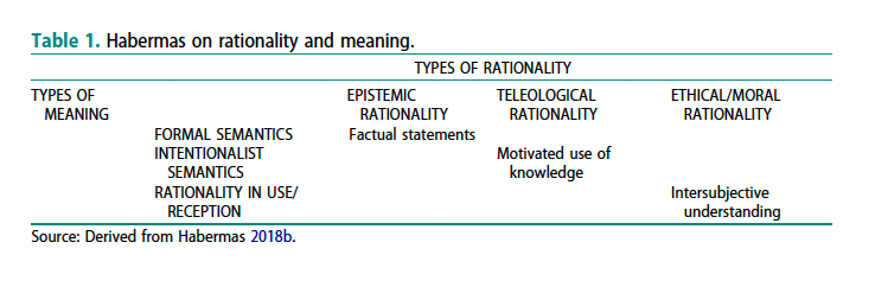
For Habermas, truth is not simply derived from factual claims. The pursuit of truth can and should include purposive action, as well as motivation towards the common good. Without these conditions, claims to the truth will be contested. While Habermas rarely used the term ‘trust’ in his work, I would suggest that it is the combination of empathy and justice on the part of speakers, combined with the ability to be read and understood by diverse communities, that constitutes the basis for trustworthy communication.
Trust, truth, politics and social media
The relationship between truth and trust has never been a straightforward one. While the internet, social media and AI enable misinformation to be created and circulated more rapidly, attempts to manipulate public opinion by appealing to emotion rather than reason are not new. It is important to see misinformation as part of a long history of propaganda, political spin and the circulation of conspiracy theories, rather than the demise of rationality as such. Rationality and emotion, truth and propaganda, and contested facts are all part of the messy reality of life in liberal democratic polities.
A major change factor has been the rise of populist insurgencies, which has had a particularly strong effect on the politics of the right and center-right. The French political economist Thomas Piketty and his collaborators have argued that it is education, rather than social class, that increasingly divides the parties of the left and right. In this environment, expertise is equated with being politically ‘on the left,’ and being part of the self-serving elite, by the ‘left-behinds’.
As public statements become filtered through political affiliation and in-group identification, particularly through social media, expertise has become increasingly suspect to some on the right, for whom the political orientation of speakers is more important than their adherence to facts. Silvio Waisbord has described the populist view of politics as conflict-centred, where ‘the notion of ‘the communicative commons’ has no value’, and the public sphere as envisioned by progressive theorists—made up of consultation, deliberation, and compromise—is treated with disdain.
But to call this ‘post-truth’, and to counterpose it to an earlier era where consensus prevailed around self-evident facts, is to confuse the politics of the moment with a fundamental shift in knowledge. We have not moved from an era of truth to one of post-truth.
This post gives the views of the author and not the position of the Media@LSE blog, nor of the London School of Economics and Political Science. It draws upon a recent article: Flew, T. (2026). Trust, mediatization and mediated trust: beyond post-truth and misinformation. Journal of Multicultural Discourses, Vol. 20, Nos. 3-4, pp. 257-268.