Australia’s Social Media Minimum Age Restrictions and the Policy Cycle

The implementation of minimum age restrictions on access to selected social media platforms for under-16s has given Australia a unique position in what has become a global debate about social media age-based bans. Five other countries having now adopted such measures – Indonesia, Malaysia, Vietnam, China and Brazil – and at least 24 other countries considering such policies, including the United Kingdom (UK), France and Canada. As a result, Australia has acquired a position in global Internet policy debates incommensurate with its overall size and significance in the global digital economy.
Back to the Future? How Rebundling Digital Content Shapes the Future of News Subscriptions

In an era defined by hybrid media systems, high-choice media environments and competition for attention, news publishers face a critical question of how can they convince audiences to pay for online journalism when the internet is flooded with free information? Our recent study published in the Journal of Media Business Studies (June 2026) titled “Back to the future? Consumer preferences for bundling news with other content” (Open Access) considers whether the possibility of bunding news with other paid services can provide the answer.
Killing the chicken to scare the monkey: the curious progressive urge to take down Australia’s social media minimum age rules

Evidence from Australia after three months of the Online Safety (Social Media Minimum Age Amendment) Act is that outcomes have been ambiguous. A Compliance Update Report released by the Office of the eSafety Commissioner in March 2026 found that while almost half of surveyed parents had at least one child with their own social media account prior to the restrictions coming into effect, this proportion had decreased to nearly one third following implementation of the ban. Notably, of the parents who reported their child had an account on each platform prior to 10 December 2025, around 7 in 10 reported that their child still had an account, with only 3 in 10 reporting that their child no longer had an account.
Why we are not in a post-truth era

Discussions about trust have characteristically tied the concept closely to that of truth. When we are asked why we consider a particular person trustworthy, the question of whether they tell the truth is likely to feature highly. As the great physicist and Nobel Prize winner Albert Einstein observed, ‘Whoever is careless with the truth in small matters cannot be trusted with important matters’.
To age-gate or not to age-gate? The Australian Social Media Minimum Age legislation and its international impact

When Australia implemented the world’s first legislated social media minimum age restrictions on 10 December 2025, it attracted significant global attention. The Australian Science Media Centre recorded that the 52 academics registered as experts on the subject were sourced in over 2600 news items worldwide in December 2025 alone. It was extensively covered by virtually every major international news outlet, and I did interviews with BBC, CNN, Al-Jazeera, The Times, Asahi Shimbun and many others.
AI and Communication: Trust, Ethics, Justice and Policy
Professor Terry Flew was honoured to be an invited keynote speaker for Charles Sturt University’s 50 Years and Beyond: School of Information and Communication Studies “Thoughts on the Beyond” Public Lecture Series. In his address, Professor Flew explored the evolving frontiers of media, communication, and digital society, reflecting on how the past five decades of scholarship can inform the challenges and opportunities that lie ahead.
Trust, Institutions and Governance
These are a series of seminars for post-doctoral fellows, PhD students and the Mediated Trust research team on the theme of “Trust, Institutions and Governance”. The aims of the seminars are:
To ground the concept of trust in institutions and organisations, as an intermediate (meso) point between interpersonal and societal trust.
To consider leading theories of trust, truth and communication, and consensus, critical and conflict models of social order, and how they shape understandings of trust.
To discuss institutionalism as a set of theories and methods that can inform the study of trust by grounding it in the historical development of social institutions.
To consider the concept of governance as a way of understanding contemporary forms of politics, power and regulation.
What does trust mean in the age of AI?
Professor Terry Flew explores the evolving concept of trust in the context of media, technology, and artificial intelligence. He highlights how AI challenges traditional notions of human-machine interaction, raising concerns about authenticity and reliability.
My Summer reading – Simon Schama, Citizens
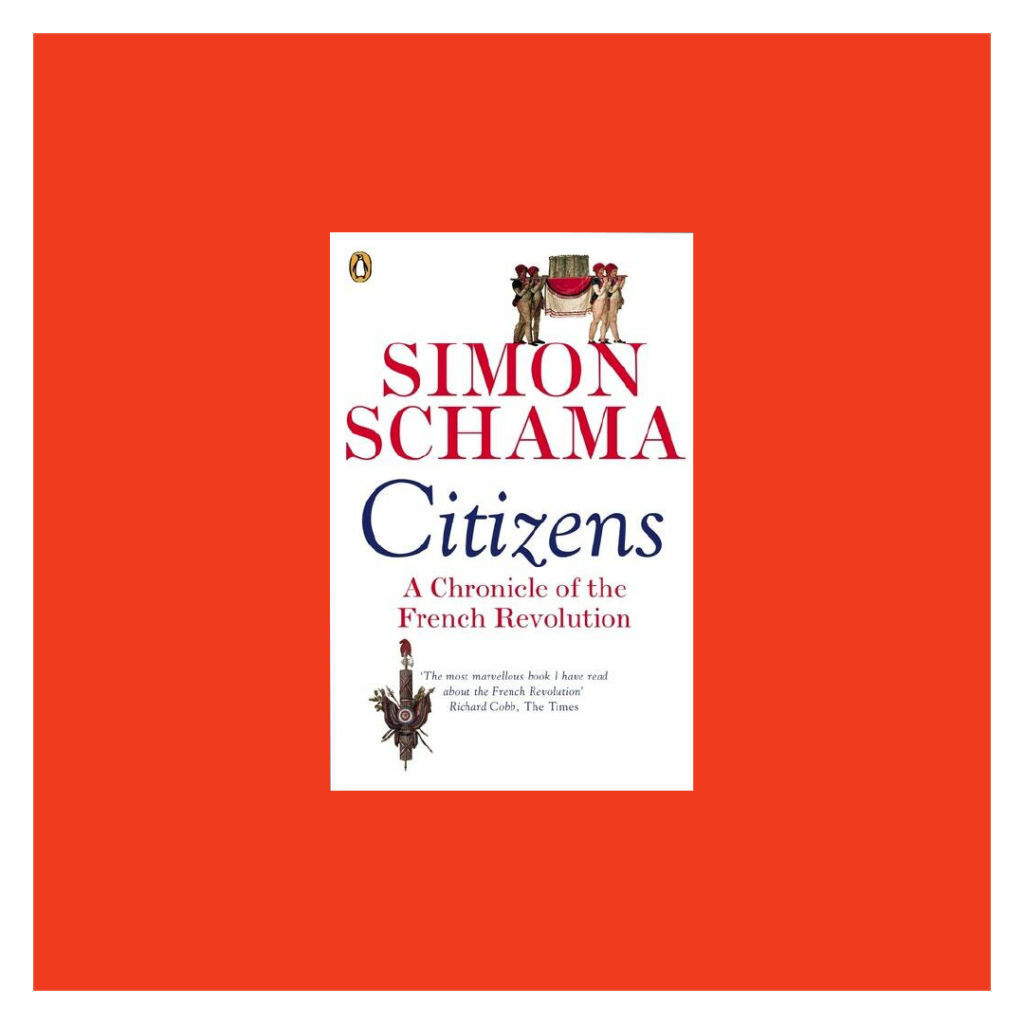
My summer reading for 2025 was Simon Schama’s very influential 1989 book Citizens, a Chronicle of the French Revolution. Not surprisingly, I was led to this book by listening to The Rest is History podcast, which brings out the full array of colourful characters associated with this eventful period of history.