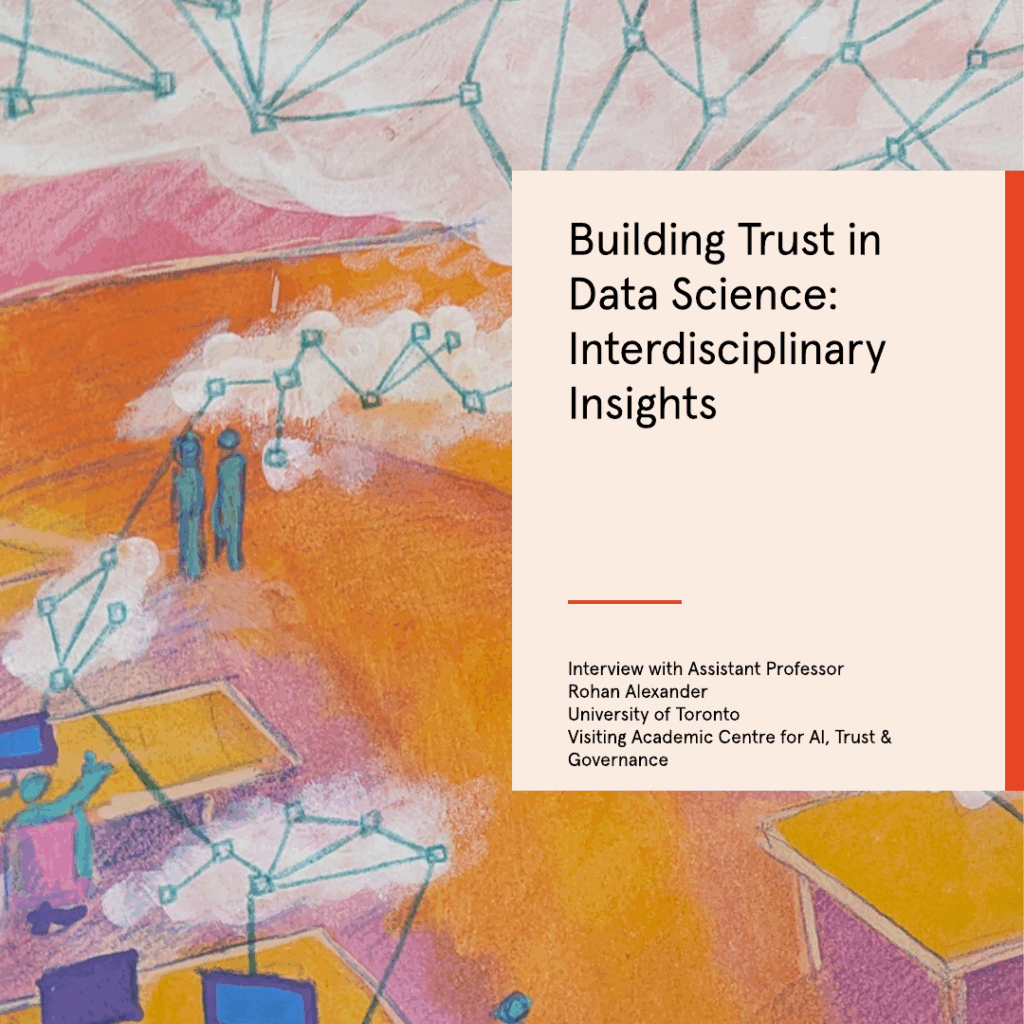
Building Trust in Data Science: Interdisciplinary Insights from Rohan Alexander

Join Associate Professor Rohan Alexander from the University of Toronto as he explores the intersection of economic history, data science, and artificial intelligence.

In this engaging talk, Rohan shares his interdisciplinary journey, collaborative research efforts, and the challenges of building trustworthy, reproducible workflows. From sparse matrices to the evolving role of large language models, he reflects on how AI is reshaping coding practices and the broader implications for society. Whether you’re a researcher, technologist, or simply curious about the future of data science, this conversation offers thoughtful insights into where we stand on the AI frontier – and where we might be headed.

Transcipt

“My background is in economic history, and I currently hold an appointment in both the Faculty of Information and the Statistics Department, which makes my work highly interdisciplinary. That was one of the main attractions of coming to Sydney – the strong culture of interdisciplinary collaboration here.

I think CrowdTangle did a good job in the labor space, and there was a lot of overlap with Francesco’s interests. As a result, we’ve been working together to apply for grants, conduct joint research.

For a long time, we’ve been writing code and putting it online, which is great. But we’ve come to realise that doing so can lead to errors and mistakes.

I’m really interested in how we can build trustworthy data science. How can we develop reproducible workflows that allow us to trust our analytical results? That involves improving our coding practices, writing tests, and taking advantage of advances in computer science.

These days, it’s all about AI and large language models, which we’re exploring to help improve our coding. Right now, I see it as an emerging technology, and we’re trying to figure out its appropriate role in data science. Can AI actually perform autonomous analysis of a project? And beyond data science, what is its appropriate role in society more broadly?

Ultimately, we’re trying to understand: where are we on the AI frontier, and what does that boundary look like?”

Image credit: Jamillah Knowles & Digit / https://betterimagesofai.org / https://creativecommons.org/licenses/by/4.0/
Share this article

Related Articles

Killing the chicken to scare the monkey: the curious progressive urge to take down Australia’s social media minimum age rules

Evidence from Australia after three months of the Online Safety (Social Media Minimum Age Amendment) Act is that outcomes have been ambiguous. A Compliance Update Report released by the Office of the eSafety Commissioner in March 2026 found that while almost half of surveyed parents had at least one child with their own social media account prior to the restrictions coming into effect, this proportion had decreased to nearly one third following implementation of the ban. Notably, of the parents who reported their child had an account on each platform prior to 10 December 2025, around 7 in 10 reported that their child still had an account, with only 3 in 10 reporting that their child no longer had an account.

Why we are not in a post-truth era

Discussions about trust have characteristically tied the concept closely to that of truth. When we are asked why we consider a particular person trustworthy, the question of whether they tell the truth is likely to feature highly. As the great physicist and Nobel Prize winner Albert Einstein observed, ‘Whoever is careless with the truth in small matters cannot be trusted with important matters’.

To age-gate or not to age-gate? The Australian Social Media Minimum Age legislation and its international impact

When Australia implemented the world’s first legislated social media minimum age  restrictions on 10 December 2025, it attracted significant global attention. The Australian Science Media Centre recorded that the 52 academics registered as experts on the subject were sourced in over 2600 news items worldwide in December 2025 alone. It was extensively covered by virtually every major international news outlet, and I did interviews with BBC, CNN, Al-Jazeera, The Times, Asahi Shimbun and many others.  

Time for Trust: Can we trust Hollywood?

In this episode, Associate Professor Bruce Isaacs dives into the crisis of trust in images – from Hollywood to Instagram – and explains why we may no longer know what’s real. It’s a timely, provocative discussion about how cinema, digital media and AI are reshaping our relationship to truth itself.