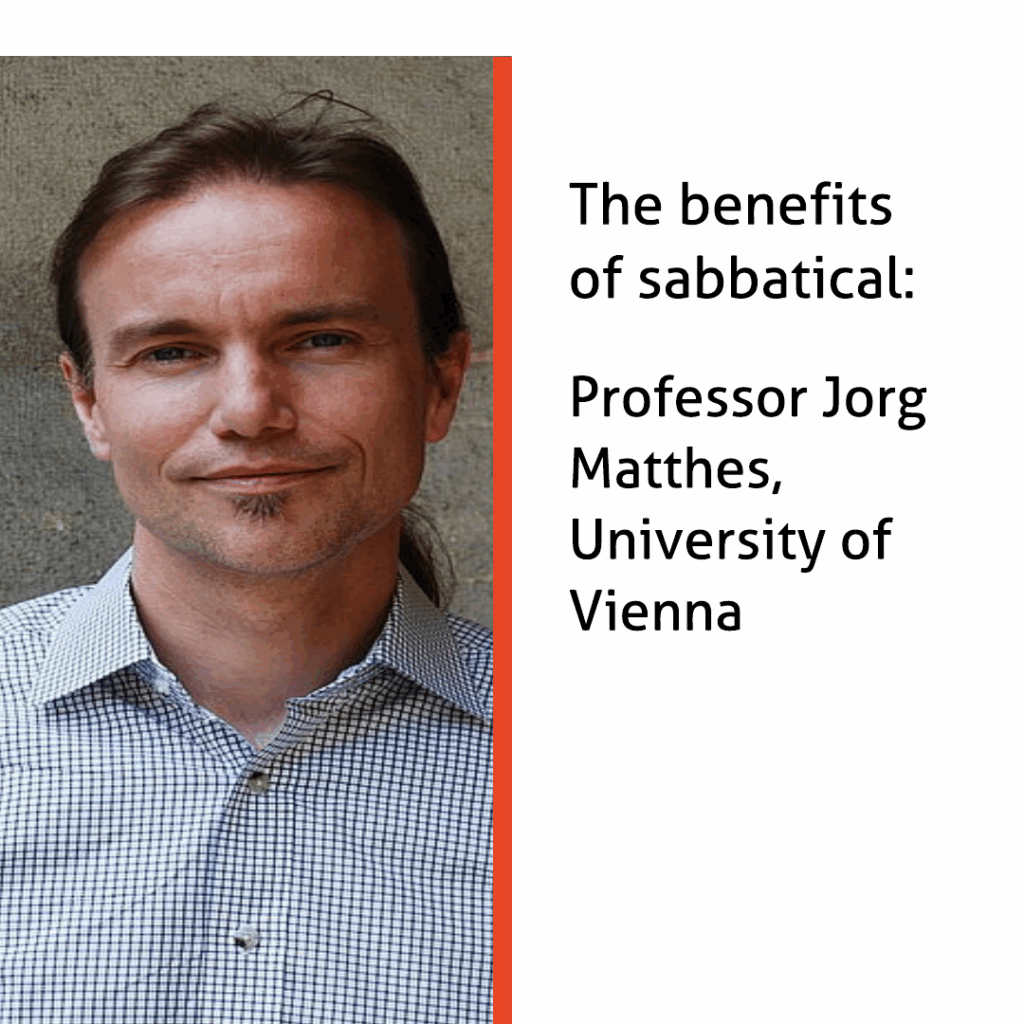
Exploring new perspectives through sabbatical

We were delighted to host Professor Jörg Matthes from the University of Vienna during his recent sabbatical with the Mediated Trust team in Sydney.

As Professor Matthes shared, the benefits of a sabbatical are both professional and personal. Stepping back from routine offers a rare chance to gain distance, reflect deeply, and see both life and research with renewed clarity. It’s in these moments of pause that new ideas emerge and long-held assumptions are re-examined.

“The benefits of taking a sabbatical are always twofold—professional and, of course, personal. Sometimes, as in life, when you gain a certain distance from yourself, you begin to see things more clearly. The same applies to research. A sabbatical gives you a different perspective: more time to think, more time to reflect, and more space to make informed decisions about the direction of your work.

Interestingly, when I started as a master’s student in psychology, my thesis focused on trust in news media. So when I saw the focus on trust here at the university, I was immediately intrigued.

Although I’ve only been here a short time, we’ve already launched a special issue for the Journal of Broadcasting & Electronic Media on the topic of trust in generative AI. I also recorded an episode for the podcast series Time for Trust, which I really enjoyed—it was thought-provoking and insightful.

This time has also allowed me to reflect on the broader discourse, and to learn more about how the conversation around trust is unfolding in Australia compared to Europe. Overall, it’s been a deeply enriching experience.”


Share this article

Related Articles

To age-gate or not to age-gate? The Australian Social Media Minimum Age legislation and its international impact

When Australia implemented the world’s first legislated social media minimum age  restrictions on 10 December 2025, it attracted significant global attention. The Australian Science Media Centre recorded that the 52 academics registered as experts on the subject were sourced in over 2600 news items worldwide in December 2025 alone. It was extensively covered by virtually every major international news outlet, and I did interviews with BBC, CNN, Al-Jazeera, The Times, Asahi Shimbun and many others.  

Time for Trust: Can we trust Hollywood?

In this episode, Associate Professor Bruce Isaacs dives into the crisis of trust in images – from Hollywood to Instagram – and explains why we may no longer know what’s real. It’s a timely, provocative discussion about how cinema, digital media and AI are reshaping our relationship to truth itself.

Summer Reflections on Australia’s Social Media Minimum Age Laws

It is unusual to find yourself as a digital media researcher in Australia being at the forefront of global policy debates. Given the talk about the three great Digital Empires – the US, EU and China – who set the global agenda, the place for middle-sized powers to be taking a policy lead around digital tech would seem to be limited.

How do Platforms Matter?

The paper ‘How do platforms matter? Media power, platform power and the digital domination of Australian media’, co-authored by Terry Flew (University of Sydney) and Cameron McTernan (Adelaide University) has now been published by International Communications Gazette. The paper is part of a special issue ‘Networks of Power: Media and Internet Concentration, Platform Capitalism, and the Future of Democracy’, edited by Dwayne Winseck (Carleton University). The special issue is part of the Global Media and Internet Concentration Project (GMICP), funded through the Canadian Social Sciences and Humanities Research Council.