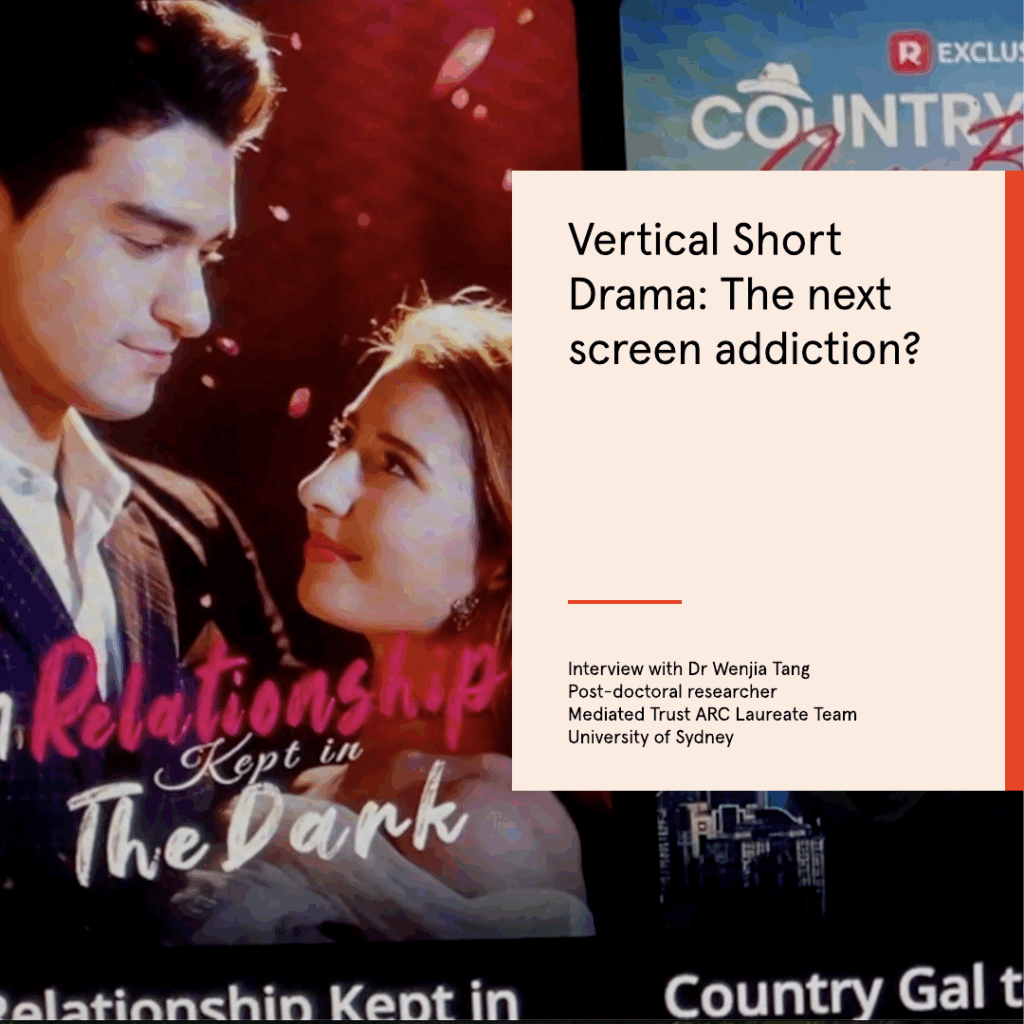
Vertical Short Drama: The next screen addiction? Insights from Dr Wenjia Tang

Dr Wenjia Tang, post-doctoral researcher with the Mediated Trust ARC Laureate team, explores the rise of vertical short drama — a fast-growing format reshaping screen culture. In this talk, Dr Tang examines how mobile-first storytelling platforms are transforming audience habits, merging social media aesthetics with narrative content, and raising new questions about attention, monetisation, and media addiction in the digital age.

Transcipt

Dr Wenjia Tang, post-doctoral researcher with the Mediated Trust ARC Laureate team, explores the rise of vertical short drama, a fast-growing format reshaping screen culture. In this talk, Dr Tang examines how mobile-first storytelling platforms are transforming audience habits, merging social media aesthetics with narrative content, and raising new questions about attention, monetisation, and media addiction in the digital age.

“The frame of smartphones – vertical screens – has shaped how people consume content. The way audiences understand screen consumption has evolved, and short vertical films are now one of the available options. These resemble traditional long-form streaming media but carry characteristics of modern screen consumption. Some platforms even have dedicated channels circulating short narrative storytelling.

For example, one episode might depict a character experiencing fear, getting pregnant, and having a miscarriage, all within a few minutes.

If you’re new to the platform, you can watch the first episode for free. But if you want to continue the story, you need to pay. In 2024, the market value of this format reached $1.7 billion.

Its popularity stems from how well it aligns with the rules of social media. These platforms use hashtags and circulate content on TikTok and Instagram.

RealShort is the first platform to build a business around short-run content. Their shows receive hundreds of millions of views. On the homepage, if you click “Show,” it leads you to all the apps they offer. You can browse categories like “Identity” or “Story Bits”, and these are the genres you can choose from.

There’s a lot of research on Netflix and other long-form streaming platforms, but it’s hard to imagine watching a full Netflix episode while waiting for your boss or during a 10-minute lunch break. There’s a clear market demand for short-form content, and people are willing to pay for it.

We want to understand why this format is so successful and explore how it might serve as a new template for streaming content in the modern digital age.


Share this article

Related Articles

Back to the Future? How Rebundling Digital Content Shapes the Future of News Subscriptions

In an era defined by hybrid media systems, high-choice media environments and competition for attention, news publishers face a critical question of how can they convince audiences to pay for online journalism when the internet is flooded with free information? Our recent study published in the Journal of Media Business Studies (June 2026) titled “Back to the future? Consumer preferences for bundling news with other content” (Open Access) considers whether the possibility of bunding news with other paid services can provide the answer.

Killing the chicken to scare the monkey: the curious progressive urge to take down Australia’s social media minimum age rules

Evidence from Australia after three months of the Online Safety (Social Media Minimum Age Amendment) Act is that outcomes have been ambiguous. A Compliance Update Report released by the Office of the eSafety Commissioner in March 2026 found that while almost half of surveyed parents had at least one child with their own social media account prior to the restrictions coming into effect, this proportion had decreased to nearly one third following implementation of the ban. Notably, of the parents who reported their child had an account on each platform prior to 10 December 2025, around 7 in 10 reported that their child still had an account, with only 3 in 10 reporting that their child no longer had an account.

Why we are not in a post-truth era

Discussions about trust have characteristically tied the concept closely to that of truth. When we are asked why we consider a particular person trustworthy, the question of whether they tell the truth is likely to feature highly. As the great physicist and Nobel Prize winner Albert Einstein observed, ‘Whoever is careless with the truth in small matters cannot be trusted with important matters’.

To age-gate or not to age-gate? The Australian Social Media Minimum Age legislation and its international impact

When Australia implemented the world’s first legislated social media minimum age  restrictions on 10 December 2025, it attracted significant global attention. The Australian Science Media Centre recorded that the 52 academics registered as experts on the subject were sourced in over 2600 news items worldwide in December 2025 alone. It was extensively covered by virtually every major international news outlet, and I did interviews with BBC, CNN, Al-Jazeera, The Times, Asahi Shimbun and many others.