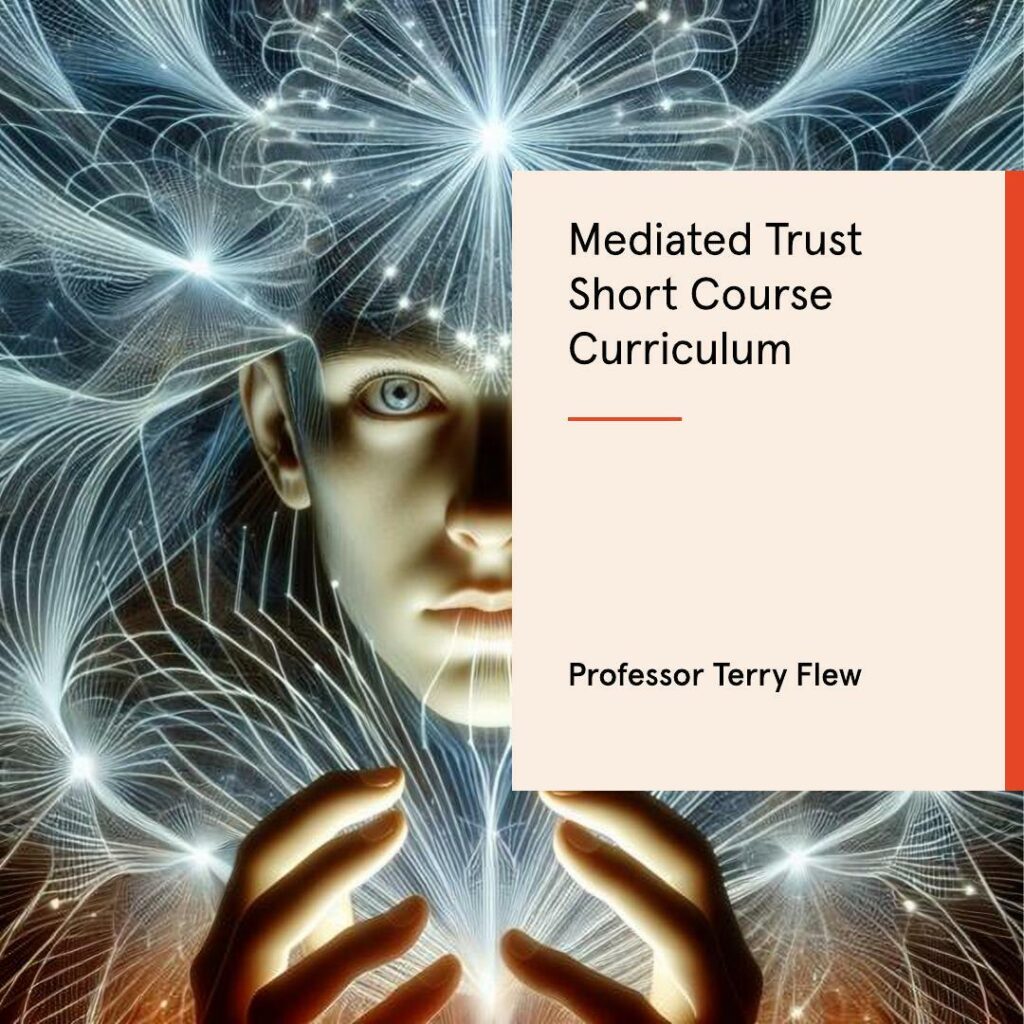
I have developed a short course curriculum on Trust as part of my Mediated Trust ARC Laureate. Over a 13 week period, we will examine different theories and disciplinary traditions associated with the concept of trust, practical applications of trust theory to news, digital platforms and public policy, and trust futures in an age of populism and artificial intelligence.
This curriculum is shown below.
Mediated Trust
Reading list for a short course convened by Australian Research Council (ARC) Laureate Fellow, Professor Terry Flew
Media and Communication, Faculty of Arts and Social Sciences, The University of Sydney.
August-November 2024
Week 1 — Introduction to Trust
Flew, T. (2021). The Global Trust Deficit Disorder: A Communications Perspective on Trust in the Time of Global Pandemics. Journal of Communication, 71(2), 163–186.
Hosking, G. A. (2014). Trust: A History. Oxford University Press, Ch. 2.
Robbins, B. (2016). What is Trust? A Multidisciplinary Review, Critique, and Synthesis. Sociology Compass, 10(10), 972–986.
Week 2 — Philosophical Perspectives on Trust
Hawley, K. (2019). How to be Trustworthy. Oxford University Press, Ch. 1.
Jones, K. (2013). Distrusting the Trustworthy. In Reading Onora O’Neill (pp. 186–198). Routledge.
O’Neill, O. (2002). A Question of Trust. Cambridge University Press, Ch. 1.
Week 3 — Sociology of Trust
Barbalet, J. (2019). Trust: Condition of action or condition of appraisal? International Sociology, 34(1), 83–98.
Mollering, G. (2006). Trust: Reason, Routine, Reflexivity. Elsevier.
Nau, H. H. (2005). Institutional, evolutionary and cultural aspects in Max Weber’s social economics. Papers in Political Economy, 49(2), 127–142.
Simmel, G. (1910). How is Society Possible? American Journal of Sociology, 16(3), 372–391.
Week 4 — Trust and Modernity
Beck, U. (1992). How Modern is Modern Society? Theory, Culture & Society, 9(1), 163–169.
Giddens, A. (1990). The Consequences of Modernity. Polity Pres, 79–111.
Luhmann, N. (2017). Trust and Power (2nd ed.). Polity Press, pp. 5–111, 27–35, 53–67.
Misztal, B. (1996). Trust in Modern Societies. Polity, Ch. 3.
Week 5 — Trust and Economics
Arrow, K. J. (2013). The Limits of Organization (5th ed.). W. W. Norton & Co, pp. 22–29.
Hardin, R. (2006). Trust. Polity, Ch. 2.
Hollis, M. (1998). Trust Within Reason. Cambridge University Press, Ch. 1.
Tullock, G. (1985). Adam Smith and the Prisoners’ Dilemma. Quarterly Journal of Economics, 100, 1073–1081.
Williamson, O. E. (1993). Calculativeness, Trust, and Economic Organization. Journal of Law and Economics, 36(3), 453–486.
Week 6 — Politics and Government
Norris, P. (2011). Democratic Deficit: Critical Citizens Revisited. Cambridge University Press, Ch. 1
Rosenfeld, S. (2019). Democracy and Truth: A Short History. University of Pennsylvania Press, Ch. 1
Rosunvallon, P. (2018). Good Government: Democracy Beyond Elections. Harvard University Press, Ch. 11.
Week 7 — Trust and Communication: Mediated Trust
Blöbaum, B. (2021). Some Thoughts on the Nature of Trust: Concept, Models and Theory. In Trust and Communication: Findings and Implications of Trust Research (pp. 3–28). Springer.
Bodò, B. (2021). Mediated trust: A theoretical framework to address the trustworthiness of technological trust mediators. New Media & Society, 23(9), 2668–2690.
Flew, T. (2024). Mediated Trust, the Internet, and Artificial Intelligence: Ideas, Interests, Institutions, Futures. Policy & Internet, 16(2), 443–457.
Schäfer, M. (2016). Mediated trust in science: Concept, measurement and perspectives for the ‘science of science communication.’ Journal of Science Communication, 15(5), 1–7.
Week 8 — Trust and News
Banerjee, S., Mont’Alverne, C., Arguedas, A. R., Toff, B., Fletcher, R., & Neilsen, R. K. (2023). Strategies for Building Trust in News: What the Public Say They Want Across Four Countries. Reuters Institute for the Study of Journalism. https://reutersinstitute.politics.ox.ac.uk/strategies-building-trust-news-what-public-say-they-want-across-four-countries
Coleman, S. (2012). Believing the news: From sinking trust to atrophied efficacy. European Journal of Communication, 27(1), 35–45.
Nelson, J., & Lewis, S. (2023). Only “sheep” trust journalists? How citizens’ self-perceptions shape their approach to news. New Media & Society, 25(7), 1522–1541.
Strömback, J., Tsfati, Y., Boomgaarden, H., Damstra, A., Lindgren, A., Vliegenthart, R., & Lindholm, T. (2020). News media trust and its impact on media use: Toward a framework for future research. Annals of the International Communication Association, 46(2), 139–156.
Week 9 — Trust and Public Policy
Kettl, D. (2017). Can Governments Earn Our Trust? Polity.
Newton, K., Stolle, D., & Zmerli, S. (2018). Social and Political Trust. In The Oxford Handbook of Social and Political Trust (pp. 37–56). Oxford University Press.
OECD. (2024). OECD Survey on Drivers of Trust in Public Institutions — 2024 Results: BUILDING TRUST IN A COMPLEX POLICY ENVIRONMENT. OECD Publishing.
The Senate Legal and Constitutional Affairs & References Committee. (2021). Nationhood, national identity and democracy. Commonwealth of Australia. https://www.aph.gov.au/Parliamentary_Business/Committees/Senate/Legal_and_Constitutional_Affairs/Nationhood/Report
Uslaner, E. (2015). Political Trust. In International Encyclopedia of the Social & Behavioral Sciences (2nd ed., pp. 658–663). Elsevier.
Week 10 — Trust and Social Cohesion: Social Capital Theory
Fukuyama, F. (2001). Social capital, civil society and development. Third World Quarterly, 22(1), 7–20.
Neveu, E. (2018). Bourdieu’s Capital(s): Sociologizing an Economic Concept. In The Oxford Handbook of Pierre Bourdieu (pp. 347–374). Oxford Univeristy Press.
Portes, A. (2000). The Two Meanings of Social Capital. Sociological Forum, 15(1), 1–12.
Putnam, R. D., & Goss, K. A. (2002). Introduction. In Democracies in Flux: The evolution of social capital theory in contemporary society. Oxford University Press.
Seligman, A. (1995). Animadversions upon Civil Society and Civic Virtue in the Last Decade of the Twentieth Century. In Civil Society: Theory, History, Comparison (pp. 200–223). Polity Press.
Week 11 — Digital Platforms and Trust
Camargo, C., & Simon, F. M. (2022). Mis- and disinformation studies are too big to fail: Six suggestions for the field’s future. Harvard Kennedy School (HKS) Misinformation Review, 3(5), 1–9.
Caplan, R. (2023). Networked Platform Governance: The Construction of the Democratic Platform. International Journal of Communication, 17, 3451–3472.
Cohen, J. E. (2019). Between Truth and Power: The Legal Constructions of Informational Capitalism. Oxford University Press, Ch. 6.
Entman, R. M., & Usher, N. (2018). Framing in a Fractured Democracy: Impacts of Digital Technology on Ideology, Power and Cascading Network Activation. Journal of Communication, 68(2), 298–308.
Week 12 — Populism, Nihilism and Expertise
Brown, W. (2023). Nihilistic Times: Thinking with Max Weber. Harvard University Press.
Eyal, G. (2019). The Crisis of Expertise. Polity.
Ferrari, E. (2020). Technocracy Meets Populism: The Dominant Technological Imaginary of Silicon Valley. Communication, Culture & Critique, 13(1), 121–124.
Rosunvallon, P. (2008). Counter-Democracy: Politics in an Age of Distrust. Cambridge University Press, Ch. 11.
Week 13 — Trust and Artificial Intelligence
Readings to be finalized.