
Terry Flew
This blog post is based on a presentation I gave to the LSE Research Dialogue titled ‘Ban, bandwagon or band aid: critical reflections on proposals to restrict children’s access to social media’. The event was held at the London School of Economics and Political Science on 7 May 2026, and other participants were Sonia Livingstone, Eva Lievens and Nick Couldry.
I will be posting a second article shortly that evaluates the Australian experience with social media minimum age restrictions and lessons for other countries. I have also published on this in Eureka Street.
The global spread of social media minimum age restrictions
When Australia implemented the world’s first legislated social media minimum age restrictions on 10 December 2025, it attracted significant global attention. The Australian Science Media Centre recorded that the 52 academics registered as experts on the subject were sourced in over 2600 news items worldwide in December 2025 alone. It was extensively covered by virtually every major international news outlet, and I did interviews with BBC, CNN, Al-Jazeera, The Times, Asahi Shimbun and many others.
The setting of social media minimum age restrictions has also taken off as a policy around the world. Tech Policy Press has identified eight countries where such measures have been implemented or are about to be implemented: Australia, Indonesia, Vietnam, Malaysia, China, Brazil, France and UAE. There are a further 34 countries where such measures are under consideration or proposed, including Greece, UK, Spain, Portugal, Italy, Türkiye, Thailand, South Korea, Norway, Denmark and Ecuador.
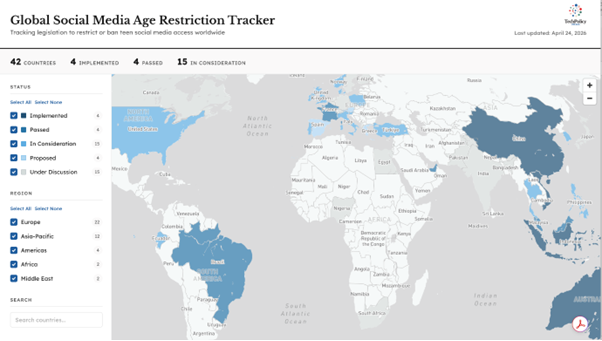
Source: Source: Tech Policy Press https://social-media-age-tracker.onrender.com/
In the UK, such laws became a flashpoint between the Starmer Labour Government and the House of Lords, with the latter passing legislation on three occasions to support such a measure. In response, the UK Government announcing in March 2026 a national 10-week consultation that aims to ‘understand how technology impacts children’s wellbeing, and what more we can do to help families strike the right balance.’
Why is age-gating social media a hot topic now?
At its simplest, these proposals are responding to public opinion. In Australia, public support for social media age restrictions has been consistently in the 60-80% range, and these policies are supported by the two major political parties. In the UK, polls by YouGov and The New Britain Project and More in Common found 75% support for a social media ban for under-16s, and a UK Youth Poll found 66% for such a measure among those aged 16-29. Comparable findings exist for many other countries, although minimum ages vary from 13 to 16 across different polls.
There is a tendency to attribute the push for such measures to media-generated moral panics. While the concept of moral panics, which has its roots in sociology and media studies going back to the 1960s, has intuitive appeal to critical academics, the set of trends and the range of countries involved suggest that it is far too diffuse a concern to have simply been whipped up by the mass media. In fact, the framing of the discourse as a ‘moral panic’, with its implied presumption that concerned parents are delusional with regards to their children, has been a disaster for those engaged in the public debate. I will return to this below.
A different way of framing this policy change would be to see it as being at the intersection of four factors. These are shown below.
Factors underpinning the rise of social media minimum age restrictions
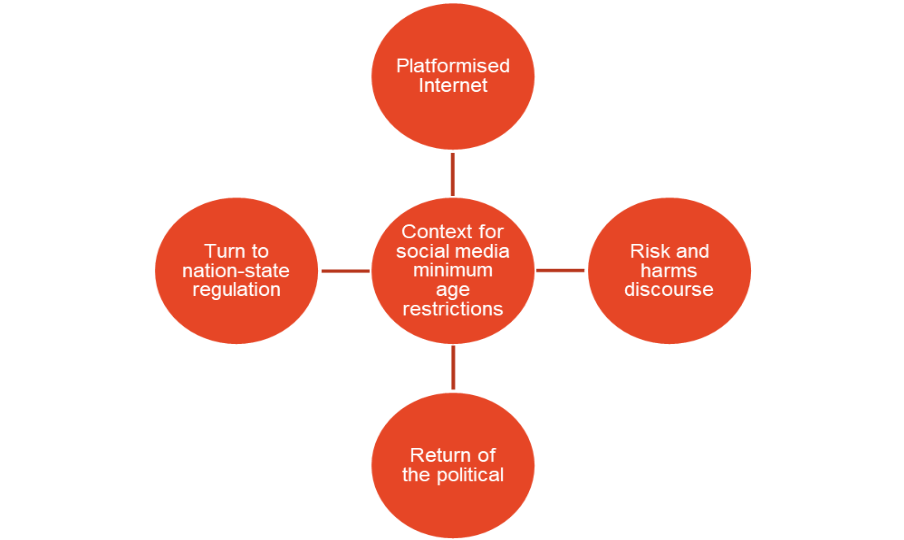
- Rise of risks and harms discourse. There was a transformation in discourses surrounding social media in the mid-2010s. It can probably be precisely dated to November 8, 2016, when Donald Trump defeated Hilary Clinton for the U.S. presidency. What was notable about the Trump campaign was how effectively it used social media, most notably Twitter (as it was then) to bypass the mainstream news media, which was largely pro-Clinton. This was in spite of the fact that social media companies were very much liberal and pro-Democrat in this period: it is estimated that only 3% of San Franciscans voted for the Trump-Pence ticket. While this did not mark the start of seeing social media as a conduit for misinformation and social harms – the first claims that the Internet was addictive can be dated to 1995 – but it did mark the point at which discourses surrounding the Internet and social media being sources of risk and harms, rather than an unambiguous net positive for social communication, came to be taken a lot more seriously by politicians, scholars and activists. The table below shows the range of neurological and psychological harms that have been associated with high levels of social media use among teenagers.

2. The platformised Internet. In my 2021 book Regulating Platforms, I identified how the open Internet of the 1990s and 2000s became the platformised Internet in the 2010s, with major digital gatekeepers such as Google, Meta, Microsoft, Apple and a small number of others. Following from a line of thinking that goes back to Karl Polanyi’s The Great Transformation, Cioffi, Kenney and Zysman identify a dialectical process in play with digital platforms, where what was once open, competitive and bottom-up becomes closed, monopolized and top-down. While this generates the enormous platform power we see today, and the associated management of online interactions to commercial ends, it triggers parallel social demands for greater regulation of the tech giants, akin to the moves to regulate the industrial monopolies of the 19th and early 20th centuries.
3. Turn to nation-state regulation. It has become increasingly apparent that the nation-state is the only entity with the capacity to effectively regulate platforms as it can combine sovereignty, legitimacy, and capacity to apply sanctions when laws are broken. The major alternative of civil society-led campaigns to promote corporate social responsibility in the tech sector lie in disarray in the post-Trump world, and industry self-regulation is largely considered a failure. There is also very little substantive impetus for binding transnational regulations, particularly as digital policy and global geopolitics have become increasingly intertwined.
4. The return of the political in Internet governance. Insofar as digital platform regulation is less the product of elite consensus and particular epistemic communities, and is more bound up with nation-state governance, it is also increasingly shaped by domestic politics. This is generating tension among large sections of expert opinion, who feel that their expertise is being sidelined in the face of electorally driven populism. This was apparent in Australia where an Open Letter signed by 140 academics, civil society organizations and children’s rights groups criticized government policy as being rushed, driven by populist media campaigns, and overly reliant upon a small number of vocal international commentators rather than the consensus views of social media researchers. In public policy terms, the question of social media minimum age restrictions has both high issue salience and the sense that there not exist practical, if difficult, steps that can be taken to address the underlying problems. It is apparent from recent Australian surveys that majority opinion supports the new laws even if many of the same people also feel the laws are being circumvented in practice.
What seems to exist is a significant disconnect between the views of many academic experts in the field and those of the wider public on social media minimum age restrictions. When UK Technology Secretary Liz Kendall MP observed that she ‘knows there are differences of opinion about a possible social media ban’ this is the divide that is primarily being referred to. The hope that a 10-week consultation process combined with a pilot study of 300 teenagers in Bradford will generate evidence that bridges the divide is a bold one indeed. As of mid-May 2026, with the Starmer Labour government now in some political turmoil, we await the outcome with great interest.
Problems with the moral panic argument
The problems with the ‘moral panic’ argument are several. First, there is confusion about whether, in the defence of social media use among young people being mounted, the focus is upon social media as normative ideal (communication beyond broadcasting) or ‘actually existing social media’ as it operates today as overseen by the world’s largest tech companies. danah boyd’s recent observation that we may now be living in an age of parasocial media, where ‘Social media stopped being primarily about connecting socially a long time ago’ (boyd, 2026, p. 3), suggests that we may now be living in a world of hyper-algorithmic one-way media challenges many of the assumptions about why we perceive as vital to defend young people’s rights to access these platforms.
Second, insofar as it it proposed that focusing on social media use is inadequate, and what is instead needed is a root-and-branch dismantling of surveillance capitalism, the question of where the political will for this would come from remains unclear. In particular, the lack of a clear program or mandate for action from voters is clearly an issue,. This is seein in the UK with the difficulties in tenacting the provisions of the Online Safety Act and keeping the Prime Minsiter interested in the topic. Moreover, all of the alternative measures proposed face the problem of opposition from the US-based tech giants and the Trump Administration, who view such policies as unfair to US companies and act accordingly.
Finally, the ‘left’ critics of social media minimum age restrictions are caught in a very uncomfortable political relationship with those libertarian voices who argue that children’s social media use is a problem of parents, not that of the state. In both Australia and the UK, it has been libertarians who are leading the campaign against social media minimum age restrictions, although there is interesting pushback from other conservatives on this.
[I note that the Digital Freedom Project, which was founded by Libertarian party NSW MLC John Ruddick and which was underwriting the High Court challenge of two 15 year olds to the legislation, no longer has a web presence, and that as of 15 may 2026 no date has been scheduled for this challenge, which was expected to be heard in February 2026].
The dismissal of public support for social media minimum age restrictions as a form of moral panic also neglects critical academic voices from within the Internet research community. One of these has been Nick Couldry at the London School of Economics and Political Science, who, in his most recent book The Space of the World: Can Human Solidarity Survive Social Media and What if it Can’t, has observed the extent to which the Internet dreams of an earlier era have gone sour:
Between two and three decades ago, humanity made a huge mistake. The mistake was to delegate to businesses, whose overriding goal is profit and value extraction, the construction and management of the spaces where our social life unfolds. We handed over to business the design of our social world. This is something we should never have done (Couldry, 2025, p. 3).
References cited
boyd, danah (2026). Social Media Is Now Parasocial Media. Social Media + Society, pp. 1-6. https://doi.org/10.1177/2056305126143748
Couldry, Nick (2025). The Space of the World: Can Human Solidarity Survive Social Media and What If It Can’t (Cambridge: Polity Press).